Astronomers from the University of Hawaii have discovered a new celestial companion orbiting the Sun alongside Earth ,a rare phenomenon known as a “quasi-moon.”
The object, designated PN7 2025 , was first detected on August 2, 2025, by the Pan-STARRS telescope. Scientists say it has been accompanying Earth for about 60 years and will continue to do so until 2083.
Spotting such quasi-moons is extremely challenging due to their small size, dark surface, and complex orbital paths. The first of these unusual companions was not even known to science until the 1990s.
At its closest, PN7 2025 approaches Earth at a distance of about 4 million kilometers ,roughly ten times the distance to our Moon ,and can drift as far as 17 million kilometers away. These fluctuations occur because its orbit slightly differs from Earth’s and is influenced by the gravitational pull of the Sun and other planets.
What is a quasi-moon?
Unlike our true Moon, PN7 2025 doesn’t orbit Earth directly. Instead, it follows the Sun along a path very similar to ours, creating the illusion of a small secondary moon traveling alongside our planet. Astronomers call these bodies “quasi-moons” ,rare space objects that share Earth’s 365-day orbit around the Sun, making them appear almost bound to our world.
A Mysterious Space Rock
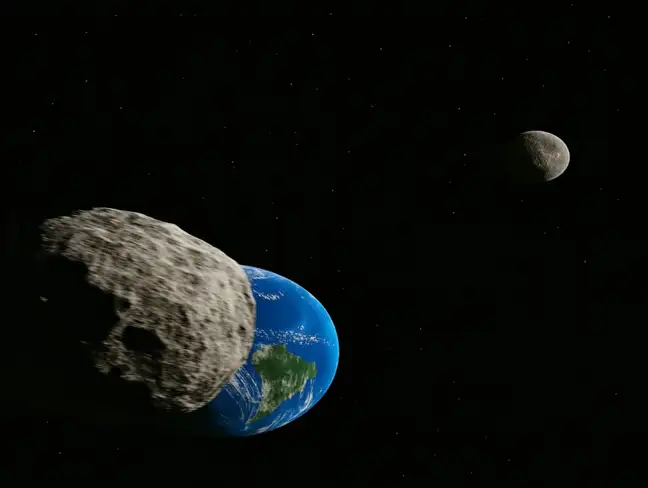
The newly discovered quasi-moon, PN7 2025 , measures between 15 and 30 meters in diameter ,about the size of a large truck or a small house. Its extremely faint brightness explains why it escaped detection for decades. Its orbit alternates between a horseshoe-shaped path relative to Earth and a loop-like orbit resembling that of a tiny moon. Currently, it is in a 1:1 orbital resonance with our planet ,meaning it takes exactly the same time as Earth to complete one orbit around the Sun.
Part of the Rare “Arjuna” Family
Scientists classify PN7 2025 as part of the Arjuna-class asteroids, a small and rare group of space rocks whose orbits are nearly identical to Earth’s ,sharing similar distances from the Sun and only slight eccentricities. These objects form what researchers describe as a “secondary asteroid belt”, much closer to Earth than any other known group, according to a study published in the Research Notes of the American Astronomical Society.
A Rare Scientific opportunity
Researchers say the discovery of PN7 2025 is a reminder that our solar system is still full of surprises. Even after centuries of observation, we continue to find new, mysterious neighbors traveling beside us. Scientists see this discovery as a unique opportunity to study how small asteroids can become temporarily captured by Earth’s orbit ,and how such interactions influence the dynamics of the inner solar system. Though PN7 2025 won’t remain forever, its slow and graceful journey around our planet beautifully illustrates the delicate gravitational choreography that governs near-Earth space.