

The 2026 FIFA World Cup, which will be jointly hosted by the United States, Canada, and Mexico, is projected to become the highest-grossing tournament in FIFA history, with expected revenues reaching $13 billion, according to a comparative overview of previous World Cup editions.
The tournament’s operational costs are estimated at around $3 billion, resulting in one of the strongest financial returns ever recorded for the global football event.
The figures place the 2026 edition well ahead of the 2022 Qatar World Cup, which generated approximately $7.57 billion in revenue. However, Qatar’s tournament remains the most expensive on record, with total investment estimated at around $220 billion, reflecting the country’s extensive infrastructure development and long-term national investment strategy.
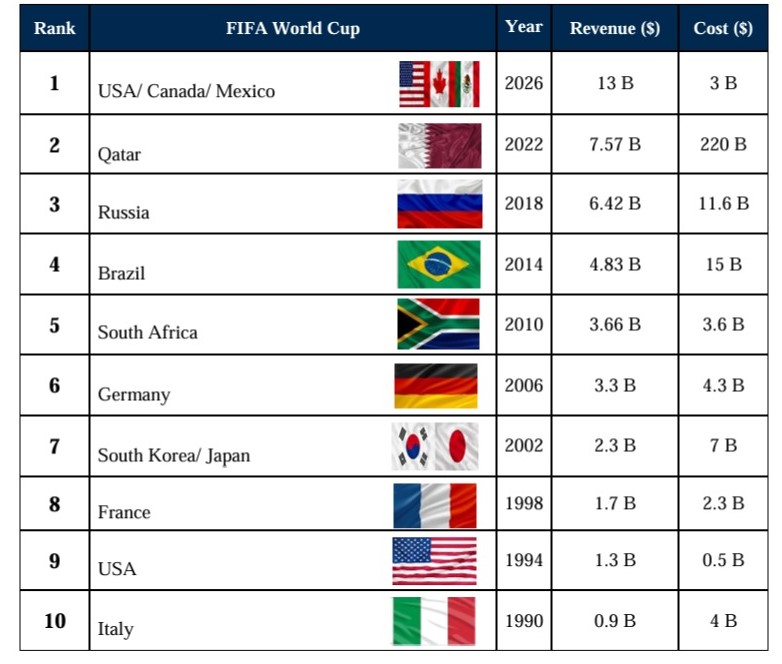
The 2018 FIFA World Cup in Russia ranked third with revenues of approximately $6.42 billion, followed by Brazil 2014 with $4.83 billion and South Africa 2010, which generated around $3.66 billion.
Among previous hosts, the 1994 World Cup in the United States stands out as one of the most cost-efficient tournaments, generating an estimated $1.3 billion in revenue while incurring costs of only $500 million.
The anticipated financial performance of the 2026 tournament highlights FIFA’s growing commercial strength, driven by an expanded 48-team format, a record number of matches, and increased global broadcasting, sponsorship, and commercial revenues. The event is widely expected to set new benchmarks for both attendance and overall economic impact.