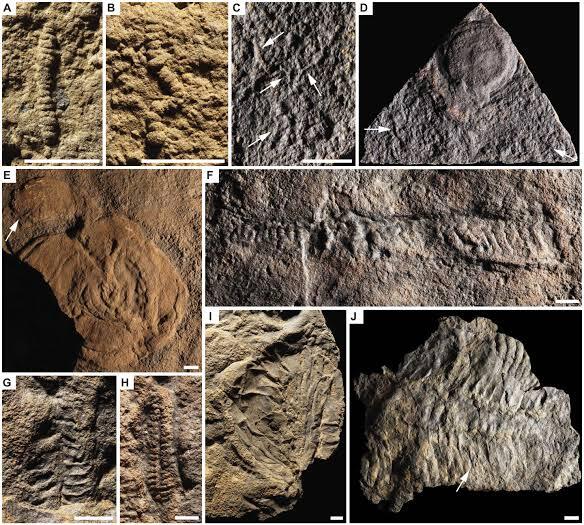

A remarkable collection of fossils discovered in Canada’s remote Mackenzie Mountains could force scientists to reconsider when some of the defining characteristics of complex animal life first emerged.
Dating back approximately 567 million years, the fossils come from the Ediacaran Period, hundreds of millions of years before the age of dinosaurs and just before the dramatic diversification of animal life known as the Cambrian Explosion.
According to a study published in Science Advances, researchers recovered more than 100 fossils, including six groups of organisms that had not previously been documented in the North American fossil record.
The findings suggest that some organisms capable of movement, reproduction and more complex body development existed between 5 and 10 million years earlier than previously documented examples had indicated.
A strange world before the Cambrian Explosion
Earth looked dramatically different 567 million years ago. Animals with shells or skeletons, along with fish, reptiles and mammals, had yet to appear. Instead, the oceans were populated by an unusual collection of soft-bodied organisms, including flat, disk-shaped creatures, plant-like forms and tubular organisms.
Among the fossils identified by the researchers was Dickinsonia, a flattened organism believed to have been capable of moving across the seafloor. The discovery also included Funisia, a tubular organism that lived in groups and is considered among the earliest evidence of reproduction in the fossil record.
Another important find was Kimberella, an organism of particular interest to paleontologists because of its body structure and possible connection to the early evolution of bilaterally symmetrical animals.
Movement and reproduction may have emerged earlier
The significance of the discovery extends beyond the age of the fossils themselves. The presence of Dickinsonia in the Canadian rocks provides evidence that mobile organisms existed around 567 million years ago.
Researchers also believe Funisia may have reproduced sexually by releasing reproductive cells into the water simultaneously, in a process comparable to reproduction observed in some modern corals.
These findings could therefore push back the fossil evidence for certain animal behaviors by 5 to 10 million years.
An unexpected setting: deeper waters
The location where these organisms lived may be just as significant as the fossils themselves.
Many previously discovered Ediacaran fossils came from relatively shallow marine environments, contributing to the idea that the early evolution of complex animals was closely associated with coastal waters.
However, analysis of the rocks and sediments at the Mackenzie Mountains site suggests that the newly discovered organisms lived in deeper marine environments.
The finding raises the possibility that deeper parts of the oceans, which may have offered relatively stable environmental conditions, played a greater role in the early development of complex animal life than previously assumed.
More than 100 fossils expand the picture
During fieldwork, scientists collected more than 100 fossils and identified a diverse range of Ediacaran organisms. Six groups had not previously been recorded in North America’s fossil history.
Some of the organisms had already been identified at younger sites elsewhere around the world. Their presence in the Canadian rocks indicates that their geographic and evolutionary distribution may have been considerably broader than the existing fossil record suggested.
While a difference of 5 to 10 million years may appear small compared with Earth’s history of more than 4.5 billion years, it represents a significant period when studying biological evolution.
The Canadian fossils therefore offer more than a glimpse into life 567 million years ago. They provide new evidence in the search for an answer to one of evolutionary science’s fundamental questions: when did animals first begin moving, reproducing and developing the complex body structures that ultimately paved the way for the extraordinary diversity of life seen on Earth today?