
The removal of a large portrait of Iran’s Supreme Leader Ali Khamenei from a building in the Iraqi city of Karbala has evolved from a local security matter into a broader political controversy, reigniting debate over Iranian influence in Iraq and the government’s efforts to reinforce state authority.
Security Action Triggers Controversy
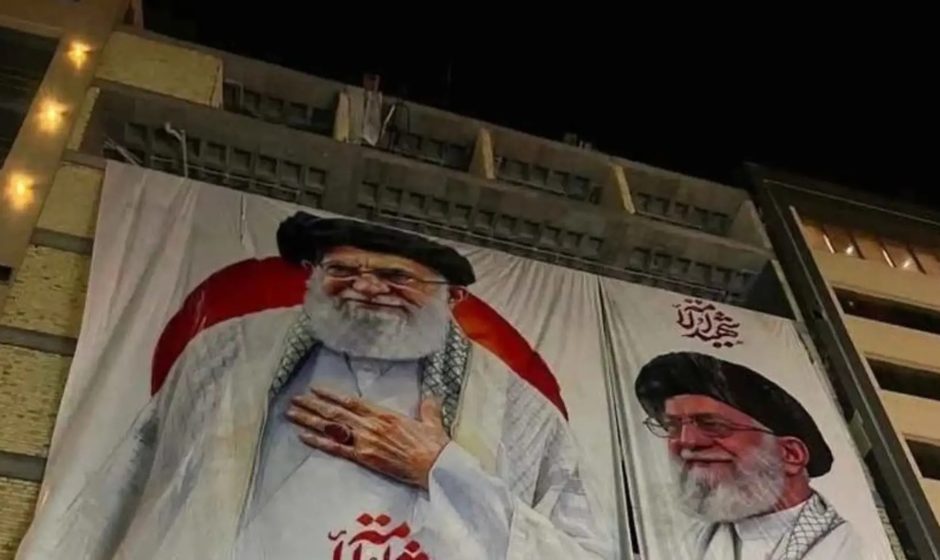
The incident began after two members of Iraq’s Popular Mobilization Forces (PMF) reportedly installed a large portrait of Khamenei on the facade of a building overlooking a major street in Karbala.
Security personnel from Iraq’s Ministry of Interior, led by Major General Anwar Al-Nasrawi, removed the banner, citing the absence of the required official approvals for displaying signs or images in the area.
Local media reported that authorities had previously instructed that no banners or portraits be placed on the building without formal authorization, in line with regulations governing public displays and religious activities in the city.
Another account suggested that the building’s owner had personally requested the removal of the portrait, prompting security forces to act while preventing any further unauthorized displays.
Political Reactions Intensify
What initially appeared to be an administrative decision quickly became politically charged.
Media outlets and online platforms affiliated with armed factions criticized the commander who ordered the removal, with some calling for legal action against him. In contrast, several politicians and commentators defended the officer, arguing that he was simply enforcing existing regulations and that the backlash reflected broader political tensions rather than the nature of the security measure itself.
Analysts say the episode has expanded into a wider debate over the limits of Iranian influence in Iraq and the government’s commitment to applying the law equally, regardless of political affiliation.
Renewed Focus on State Sovereignty
Observers note that the incident comes at a time when Prime Minister Ali Al-Zaidi has placed strengthening state institutions and enforcing the rule of law among his administration’s top priorities.
As a result, many view the Karbala incident as an important test of the government’s ability to implement its agenda of reinforcing official institutions while reducing political interference in security matters.
Echoes of Previous Incidents
The controversy also recalls similar episodes in recent years involving images of Iranian political and military figures across Iraq.
During the nationwide protests of 2019, demonstrators burned the Iranian consulate in Najaf and removed or set fire to portraits of Ali Khamenei and Qassem Soleimani in Baghdad and several southern cities, actions widely interpreted as expressions of opposition to Iranian influence.
Following the deaths of Soleimani and Iraqi militia commander Abu Mahdi al-Muhandis in early 2020, large murals honoring both figures appeared across Iraq. Some were later removed, reflecting the country’s continuing political divisions over the presence of such symbols in public spaces.
A Sensitive Political Moment
The latest dispute comes shortly after Prime Minister Al-Zaidi visited Tehran, only days after holding talks with U.S. President Donald Trump in Washington, against the backdrop of continued tensions between the United States and Iran.
Political observers believe the timing has added further significance to the incident, with many viewing it as an early indication of how the Iraqi government intends to balance domestic governance, national sovereignty, and the competing regional influences that continue to shape Iraqi politics.