
Lebanon ranks among the countries experiencing the sharpest declines in living standards since 2008, with real GDP per capita falling by 30%, according to World Bank data. The figures highlight the lasting impact of the country’s economic crisis and its struggle to regain pre-crisis levels of prosperity.
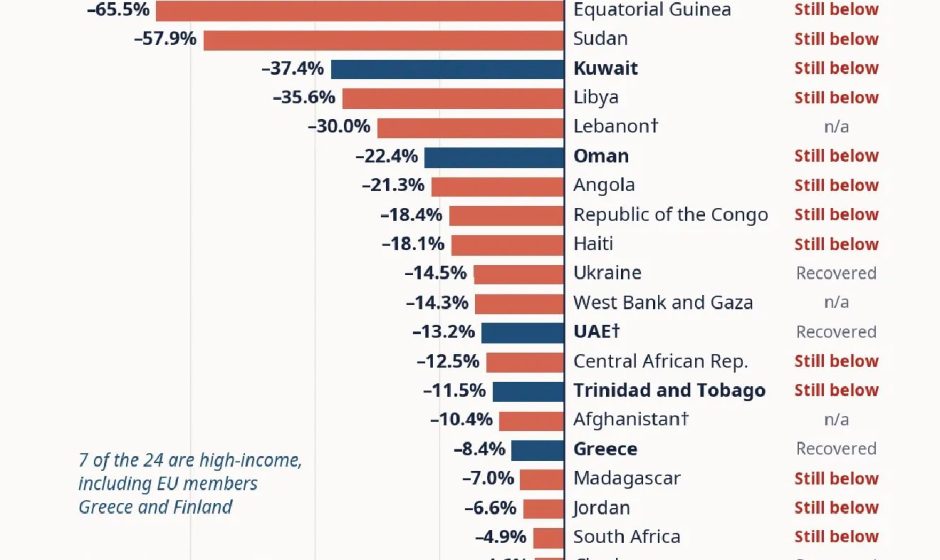
A recent economic comparison based on World Bank data reveals that Lebanon is among 24 economies worldwide, each with a population exceeding one million, where real GDP per capita remained below its 2008 level in 2025.
While global real GDP per capita increased by approximately 31% between 2008 and 2025, Lebanon recorded a substantial contraction, placing it sixth among the economies experiencing the largest declines during the period.
Lebanon Records One of the Sharpest Economic Declines
According to the figures, Venezuela experienced the steepest decline in real GDP per capita, falling by 67.4%, followed by Equatorial Guinea at 65.5% and Sudan at 57.9%.
Kuwait ranked fourth with a decline of 37.4%, followed by Libya at 35.6%, while Lebanon recorded a 30% drop.
Other countries experiencing significant contractions included Oman, where real GDP per capita declined by 22.4%, Angola at 21.3%, and the Republic of the Congo at 18.4%.
The findings illustrate the considerable economic challenges facing several countries, particularly those affected by prolonged financial instability, political crises, and structural economic weaknesses.
Lebanon’s Economic Crisis Continues to Weigh on Living Standards
Lebanon’s economic performance reflects the consequences of years of financial instability, banking sector difficulties, currency depreciation, and weakened economic activity.
The country’s financial crisis, which intensified in 2019, severely disrupted the banking system, reduced purchasing power, and undermined confidence in financial institutions.
Despite ongoing discussions surrounding financial and banking reforms, Lebanon continues to face substantial challenges in restoring sustainable economic growth.
The 30% decline in real GDP per capita underscores the scale of the country’s economic deterioration compared with its position in 2008.
However, GDP per capita is an average measure of economic output and does not directly capture household income, wealth distribution, or individual purchasing power.
IMF Outlook Suggests a Prolonged Recovery for Several Economies
The chart also incorporates projections from the International Monetary Fund’s October 2026 World Economic Outlook, providing an indication of which economies could recover to their 2008 real GDP per capita levels by 2030.
According to the projections, 13 of the 20 economies with available IMF forecasts are expected to remain below their 2008 levels by the end of the decade.
Countries including Kuwait, Oman, Libya, Equatorial Guinea, Sudan, Angola, and Jordan are projected to remain below their earlier economic benchmarks.
Meanwhile, Ukraine, the United Arab Emirates, Greece, Qatar, Finland, Chad, and Namibia are projected to recover to or exceed their 2008 levels by 2030.
Lebanon was not assigned a comparable 2030 outlook in the chart because a complete IMF projection series was unavailable.
Global Economic Growth Highlights Widening Disparities
The comparison reveals a striking contrast between global economic progress and the prolonged stagnation experienced by several individual economies.
Although worldwide real GDP per capita increased by 31% over the 17-year period, 24 economies continued to record lower levels of economic output per person than in 2008.
Seven of these economies are classified as high-income countries, including European Union members Greece and Finland.
The findings demonstrate that even relatively wealthy economies can experience extended periods of declining economic output per person.
For Lebanon, the figures reinforce the importance of addressing structural economic weaknesses, restoring confidence in the financial system, and implementing reforms capable of supporting long-term recovery.
As the country continues efforts to rebuild its economy, returning to pre-crisis levels of economic output remains a significant challenge.
Source: World Bank, World Development Indicators, updated October 8, 2026; International Monetary Fund, World Economic Outlook, October 2026.