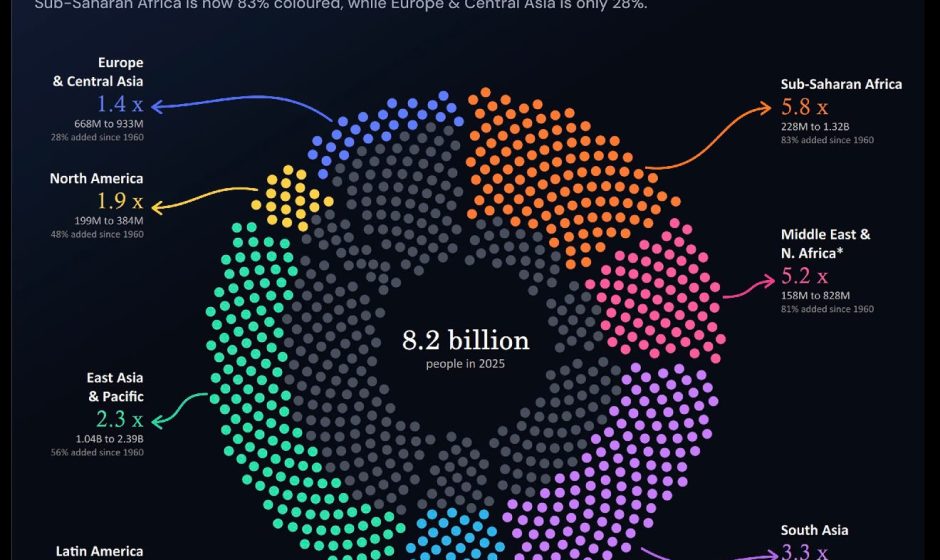

The world’s population has surged from approximately 3 billion in 1960 to 8.2 billion in 2025, with Sub-Saharan Africa and the Middle East recording the fastest population growth over the past 65 years, according to World Bank data.
The figures reveal significant differences in population growth across regions, highlighting a major shift in global demographics as developing economies account for an increasingly large share of the world’s population.
While some regions have experienced population increases of more than fivefold, others, particularly Europe and Central Asia, have recorded considerably slower growth.
Sub-Saharan Africa Leads Global Population Growth
Sub-Saharan Africa recorded the fastest population expansion between 1960 and 2025, with its population increasing from approximately 228 million to 1.32 billion.
This represents a 5.8-fold increase, making it the fastest-growing region in the comparison.
According to the data, approximately 83% of the region’s population in 2025 represents growth recorded since 1960.
The sharp increase reflects the region’s significant demographic transformation over the past six decades, with population growth creating both economic opportunities and challenges related to infrastructure, employment, education, and healthcare.
Middle East and North Africa Record Fivefold Increase
The Middle East and North Africa experienced the second-fastest population growth worldwide, expanding from approximately 158 million people in 1960 to 828 million in 2025.
The region’s population increased by a factor of 5.2, with approximately 81% of its current population representing growth since 1960.
The figures underline the scale of demographic expansion across the region, where rising populations have increased demand for housing, employment opportunities, public services, and economic development.
The World Bank regional grouping used in the data also includes Afghanistan and Pakistan.